
DNS
The resolver: how Apranik turns a domain into addresses. Every lookup goes through it: freedom reaching a destination, a proxy outbound reaching its server, a DNS server reaching its own hostname, and the routing resolve action. Without a dns section, the operating system resolves.
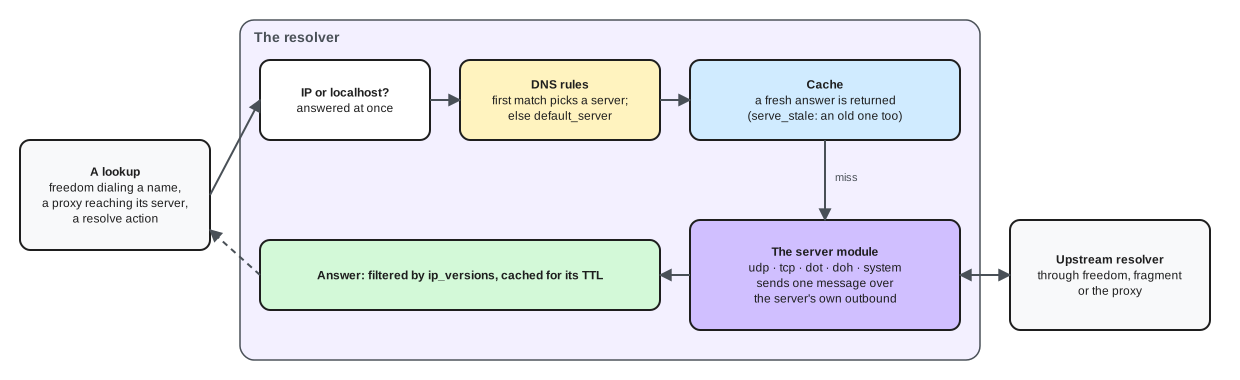
Structure
{
  "dns": {
    "servers": [
      {
        "tag": "google",
        "type": "doh",
        "settings": { "server": "8.8.8.8", "host": "dns.google" },
        "tls": { "server_name": "dns.google" },
        "outbound": "proxy"
      },
      {
        "tag": "domestic",
        "type": "udp",
        "settings": { "server": "192.0.2.53" },
        "outbound": "direct"
      }
    ],
    "rules": [
      {
        "match": { "domain_suffix": ["ir"] },
        "server": "domestic"
      }
    ],
    "default_server": "google",
    "ip_versions": "prefer_ipv4",
    "cache": {
      "disable": false,
      "max_entries": 4096,
      "per_server": false,
      "serve_stale": { "enabled": false, "max_stale_age": "1h" }
    }
  }
}
Fields
servers
list of DNS serversRequired
The servers lookups may ask. See DNS server.
rules
list of DNS rules
Which server answers which names; the first match wins. See DNS rule.
default_server
stringRequired
The tag of the server for names no rule matches.
ip_versions
stringDefault: prefer_ipv4
Which addresses a lookup asks for, and in what order:
| Value | Returns |
|---|---|
ipv4_only | IPv4 only |
ipv6_only | IPv6 only |
prefer_ipv4 | IPv4 first, then IPv6 |
prefer_ipv6 | IPv6 first, then IPv4 |
cache.disable
booleanDefault: false
Ask the server every time. Otherwise answers are kept for their TTL, and a name that does not exist for at most 5 minutes. Failures are never kept.
cache.max_entries
integerDefault: 4096
The most answers kept; the least recently used goes first. Each record type of a name is one answer.
cache.per_server
booleanDefault: false
One cache per server instead of one shared cache.
cache.serve_stale
objectDefault: off
enabled returns an expired answer at once and refreshes it in the background, while it is no older than max_stale_age (default 1h) past expiry (RFC 8767). It keeps connections working while a server is briefly unreachable.
Example: avoiding a lookup loop
A proxy whose server is a domain needs a DNS server that does not go through that proxy. Here the proxy's own name comes from the domestic resolver:
{
  "outbounds": [
    {
      "tag": "proxy",
      "server": "proxy.example.com",
      "server_port": 443,
      "transport": [{ "type": "tcp" }, { "type": "tls" }],
      "protocol": {
        "type": "trojan",
        "settings": { "password": "correct horse" }
      },
      "dns_server": "domestic"
    },
    {
      "tag": "direct",
      "protocol": { "type": "freedom" }
    }
  ],
  "dns": {
    "servers": [
      {
        "tag": "google",
        "type": "doh",
        "settings": { "server": "8.8.8.8", "host": "dns.google" },
        "outbound": "proxy"
      },
      {
        "tag": "domestic",
        "type": "udp",
        "settings": { "server": "192.0.2.53" },
        "outbound": "direct"
      }
    ],
    "default_server": "google"
  }
}
apranik check refuses a loop it can see and names every server and outbound in it.